
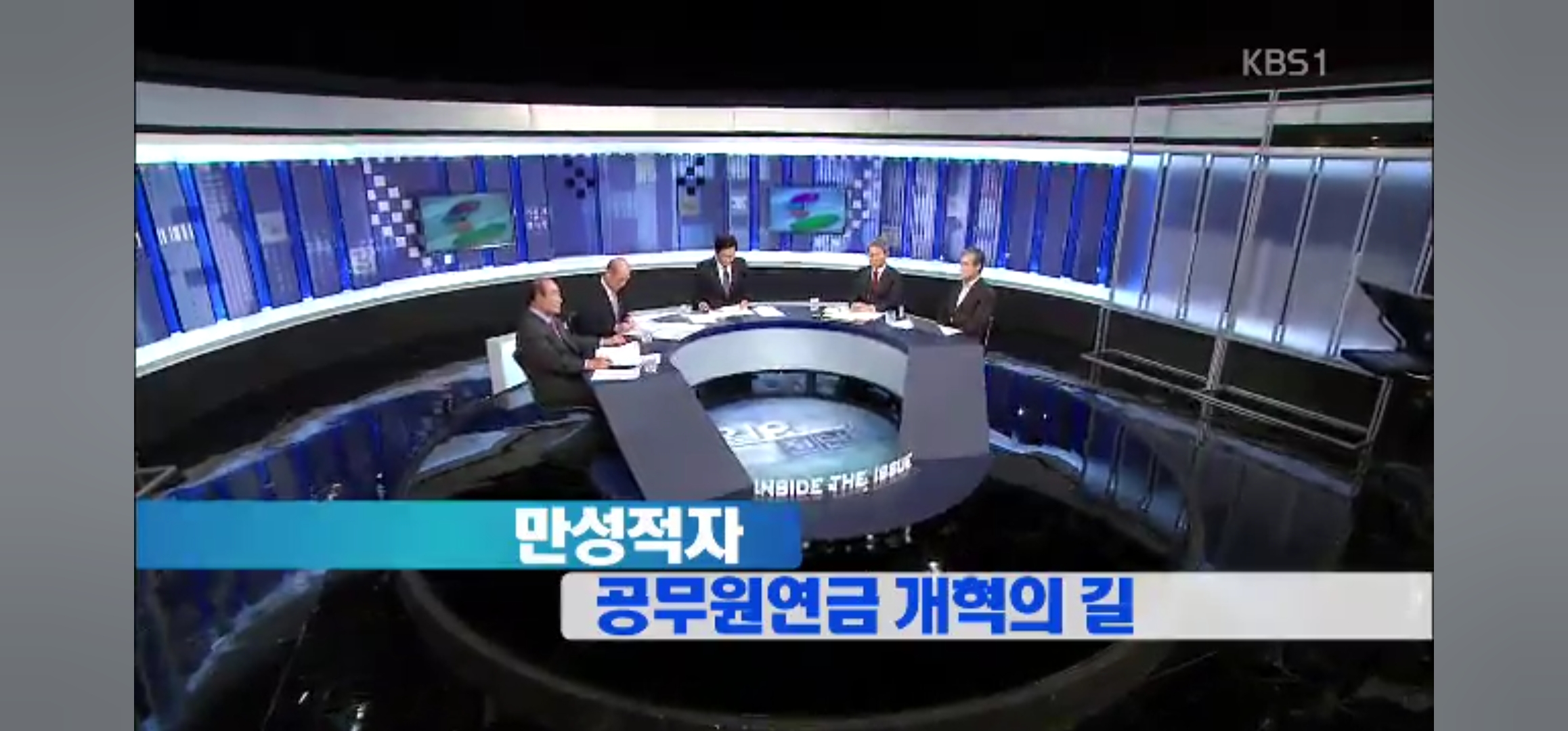
(KBS 1TV, Sunday Diagnosis Live) The Road to Reforming the “Chronically Deficit-Ridden” Government Employees Pension. November 24, 2013 (8:09 a.m.)
https://news.kbs.co.kr/news/mobile/view/view.do?ncd=2760409
-Good morning, viewers. I am Hong Ki-seop.
There is a pension whose deficits, growing larger every year, are all covered with the public’s taxes.
It is the Government Employees Pension.
This year alone, nearly 2 trillion won in taxes has been put into it, and since it will go on being like pouring water into a bottomless jar, it is threatening not only welfare programs for the poor but even the state’s finances.
Major surgery is urgently needed.
Today on KBS Sunday Diagnosis, we will examine the state of the Government Employees Pension and take a close look, together with experts, at what a desirable reform would be.
First, let me introduce today’s guests.
With us is Professor Kim Won-sik of the Division of Business and Economics at Konkuk University.
-Hello.
-Joining us is Yun Suk-myung, Director of the Pension Research Center at the Korea Institute for Health and Social Affairs.
-Hello.
-With us is Nam Sang-woo, former auditor of the Government Employees Pension Service.
You also served as mayor of Cheongju, did you not? -Pleased to meet you.
-And finally, joining us is Bae Jun-ho, Dean of the Graduate School at Hanshin University.
-Hello.
-Thank you very much for joining us despite your busy schedules.
Recently, as the controversy over the Basic Pension and the National Pension has spread, attention is now turning to the Government Employees Pension.
I think this may be because interest in the Government Employees Pension and in old-age security has grown, and in particular because questions of equity have been raised.
Let us begin by discussing what situation the Government Employees Pension is actually in right now and how serious the problem is.
Professor Kim, the Government Employees Pension turned to deficit in 2001, so it has been more than 12 years, has it not? What is the situation now? -The size of the deficit is growing especially large at present.
So right now it stands at about 2,001.7 trillion won.
There are, in fact, some reserves, but it is true that they are not contributing much to the pension’s finances.
That is because the fund is more in the nature of a contingency reserve than something meant for investment.
-But the deficit subsidy so far has actually passed some 10 trillion won.
And there are also projections that it will reach 28 trillion won over the next 10 years.
That is a rather worrying situation.
Dr. Yun, what do you think? -As was just said, it is a problem even now, but as time passes it will interlock with our population aging, and this applies equally to Government Employees Pension beneficiaries.
While the number of Government Employees Pension beneficiaries is growing, the number of serving civil servants who will pay contributions is not rising to match, so as time goes on, as was mentioned earlier, if this year’s deficit subsidy is around 1.85 trillion won, next year it is expected to exceed 2.4 trillion won.
Then it increases exponentially: if you compare the total deficit subsidy over each five-year administration, the Lee Myung-bak administration covered about 7.69 trillion won in deficits over five years, but the current administration will probably have to cover about 15 trillion won over its five years.
If it stayed at that level, it would not matter, but the deficit subsidy can only grow larger as time goes on.
From that perspective, the direct stakeholders of the Government Employees Pension say that in the past we were poorly paid, and various other things.
They say a direct comparison with the National Pension is difficult because it has various characteristics that differ from the National Pension, but fundamentally, social and economic conditions have changed enormously since this Government Employees Pension scheme was introduced in the 1960s.
Back then, life expectancy was only about 58 years, for Koreans.
Now, however, life expectancy is passing 80.
In particular, most Government Employees Pension beneficiaries have a somewhat higher life expectancy than the general public.
As a result, given that the period of receiving a pension has grown by 20 to at least 25 years compared with when the scheme was first introduced, unless the basic framework of the scheme is changed, I think it will cause a very serious problem in the long run.
-Professor Bae, Dr. Yun has just pointed out that the causes of the Government Employees Pension deteriorating under this structure include longer lifespans and, in particular, a close link with the aging society; what would you say are the reasons the Government Employees Pension’s finances got into such difficulty?
Shall we take a look? -Our Government Employees Pension actually turned to deficit in 1993, so it has been a full 20 years.
What matters about a deficit is that spending exceeds the revenue collected each year, is it not? -So the deficits arose in the 1990s, but the government began covering them, on a legal basis, from 2001; is that what you are saying? -That is right.
So basically, these deficits occur because that much less is paid in, because revenue is low: at present our civil servants pay 7% of their pay, the government also pays 7%, and then, because that falls short, the government chips in roughly another 6% or so.
So we fund the whole thing with 7% of civil servants’ total pay, that is, of their own salaries, plus about 13% from the government, which is 7% plus 6%.
In the end, it barely manages to operate each year on that.
The basic cause of these deficits at present is that the share borne by the government is somewhat small compared with other countries.
That is, here the government bears about 13% of civil servants’ pay, but in neighboring Japan it is about 26%, and in the United States about 27%; the OECD countries we benchmark against have somewhat higher government burden rates.
So rather than attributing the whole of the Government Employees Pension deficit to beneficiaries taking too much or to civil servants paying too little, I think the causes should be sought on both sides.
The government’s share is small, and the benefits our civil servants receive are somewhat high compared with civil servants in other countries.
So I think approaching it from both sides would be the right answer.
-Auditor Nam, when the Government Employees Pension issue comes up, civil servants are the beneficiaries, are they not? The beneficiaries say they are in a rather awkward position, and they say its nature is very different from other pensions, so a direct comparison is difficult, do they not? -That is right.
Many people say the Government Employees Pension’s finances are running dry, and this is how I see it.
Because of the aging of the Government Employees Pension, the number of people who must be paid is growing exponentially, while, as the anchor said earlier, the number of civil servants hardly grows because of headcount regulations.
Originally, a pension is supposed to pay beneficiaries out of civil servants’ contributions and keep that in balance, but this is not working.
For example, there are currently 1.05 million civil servants, while beneficiaries number more than 360,000.
In April 2011, when I took office as auditor of the Pension Service, there were a little over 310,000 pension beneficiaries.
But in about two and a half years, that has grown to 360,000.
That is one reason the finances are deteriorating: it is very hard for the state to take responsibility for growth that is truly this exponential.
Another is that, in the past, when the pension’s finances were sound, the government freely took the money and used it.
Put simply, the Pension Act was enacted in 1960, and up to 1965 the average age at the time—55 was mentioned earlier—was 50.
Almost no one was drawing a pension.
Yet at that time the money was used as economic development funds, for ports and road construction, and from 1982 on about 2 trillion won was taken as fiscal deposit funds.
Also, when our civil servants have done their enlisted military service, they pay more into the pension to make up for the period of that service.
They pay additional contributions, with half paid by the individual and half by the state, is that not so? But since 1982 the state has not been paying its share in full.
This comes to about 5.3 trillion won.
And civil servants are, truly, public servants employed by the state, by the employer.
When these people died or retired, the retirement benefits that really should have been paid by the government were paid out of the pension fund.
This came to about 10 trillion won, so because a total of 17 trillion won in funds was drained,
the interest on that alone could have covered everything, including the 1.87 trillion won we again put in from the budget this year, but now that cannot be done.
-I see.
-There are these problems.
-Auditor Nam,
what you are saying is that, although the government is now covering much of the Government Employees Pension’s deficit, in the past the Government Employees Pension actually played a large role for public finances.
-That is right.
-Even so, looking at the present, this year’s budget for the Basic Old-Age Pension is about 3.2 trillion won, while the Government Employees Pension’s deficit subsidy is 2 trillion won and, at 2.4 trillion won next year, is set to keep growing exponentially; how can that not be a problem? -It is a problem.
For example, in terms of equity with the National Pension, it is clearly a problem.
Because the National Pension is accumulating a fund of 400 trillion won, while on the other side there will keep being deficits of 2 or 3 trillion won every year.
In that sense it can be a problem, but basically the problem is that the Government Employees Pension has a deficit structure, actuarially and structurally.
So these phenomena actually began in the 1980s.
And in the 1980s this Government Employees Pension scheme greatly expanded its benefits.
Meanwhile, the number of civil servants kept increasing.
So, for example, the Government Employees Pension Service has been carrying a defective product all along, right up to now.
-It was neglected.
-Yes.
So almost no attention was paid to it.
And from the government’s standpoint, too, this pension structure should have been changed, but changing it would ultimately become entangled with civil servants’ demands for higher wages.
That is, if they think the pension they will receive later is shrinking, they demand a pay raise right away.
Demands arise along the lines of “Have we not served for low pay all this time?”
So in the past, since there was at least a fund accumulated in the Government Employees Pension, and there was room to use it for public investment and lending and the like, the government stood by; I see the problem as arising because the fund has in fact been depleted and the government has come to have to cover the deficits.
And now there is the continuing issue of the cumulative deficit.
For example, people say it was 10 trillion won over the past 10 years, but this should not be viewed as a cumulative-deficit problem; it is money the government promised anyway, is it not? So I think we should first examine what the annual burden will be and whether the government, whether our economy, has the capacity to bear that burden, and only then talk about structural reform of the pension.
-I see.
Recently, when the Government Employees Pension issue comes up, the issue of moral hazard is also being raised.
For example, in a situation where it depends heavily on the government because of its deficits, it even gives interest-free tuition loans to civil servants and their children.
About 200,000 people are said to benefit from this; from the public’s point of view, is that not hard to accept? -That can be very important too, but since I missed my chance earlier, I think we need to go over the structural problem now.
I will address that after I have said this.
As I said earlier, life expectancy has risen by more than 20 years.
That means the period of receiving a pension has grown by that much.
And as Professor Kim said, when the Government Employees Pension scheme was first introduced in the 1960s, it was not such a generous scheme.
Through the 1970s and 1980s the Government Employees Pension’s finances were deteriorating, yet, with few people receiving benefits at the time, income replacement kept being raised; there is that structural problem.
But whenever the Government Employees Pension comes up, the issue keeps being framed as the government having done wrong in the past; rather than that, if we look at it from the perspective of whether this scheme can be sustainable, our Government Employees Pension’s accrual rate, the pension entitlement granted for paying contributions, is 1.9.
And the National Pension’s is 1, but I will come back to the comparison with the National Pension later.
Looking at similar cases abroad, countries that provide an accrual rate of 1.9 or 1.5 have pension contribution rates of at least 23% to 28%.
Yet our Government Employees Pension pays the same benefits, and those who joined earlier are paid even more than that.
And still it collects only 14% in contributions.
So even granting that the government did something wrong in the past, it is now collecting only 50% of the contributions needed each year.
And that keeps accumulating.
So the point should be that unless the scheme is reformed quickly, the Government Employees Pension’s finances can only fester that much more; repeatedly saying that the government did this wrong and that wrong in the past, so fix that first, does not seem the right approach.
The situation is this serious; and then, looking at the National Pension, it was first introduced in 1988, so the scheme’s history is short.
With a fund of over 400 trillion won accumulated, the National Pension has already undergone major reforms twice, cutting the benefit rate by 40%.
Even though its fund has more than 400 trillion won accumulated.
Yet from the Government Employees Pension side, citing one thing or another, people keep saying the government should take prior measures rather than reform; I think many people will find it hard to sympathize with that.
And in such a bad situation, managing the fund generously on things like tuition, compared with other pension schemes, does not seem a very good example from the public’s point of view.
-Dr. Yun has just raised a very important, fundamental issue.
In terms of equity with the National Pension, it really does seem a very serious problem.
And when comparing it with the National Pension, there is the benefit-to-contribution ratio.
The ratio of what one receives to what one paid in is often compared with the National Pension, and in the case of the Government Employees Pension, one receives up to as much as 3.
7 times what one paid in.
The National Pension is up to 1.8 times, so this is already more than twice as much, is it not? Does the public not take this problem very seriously as well? -That is right.
But that is a problem of people who are already receiving pensions.
-Right.
-The pension scheme has been revised over the years, has it not, three times.
When we look at the pension scheme today, the present state of things can be seen as trouble created in the past.
We should look at how the pension scheme is set up now.
In practice, new hires.
-You mean those newly appointed since 2002.
-For new appointees, the benefit-to-contribution ratio is calculated to be 15% lower than that of existing National Pension members.
So, conversely, if new appointees think, “The Government Employees Pension scheme is good, so I should become a civil servant,” there is a problem.
Because they actually end up worse off than under the National Pension.
So from the public’s point of view one would like this effect to show up right away, but in reality it will show up 20 or 30 years from now.
So since the problem of the existing accumulated liabilities is something the government had to bear for the past anyway, I think the key going forward must be how to keep it under control within the government’s means.
-I think I need to address that point: what Professor Kim just said needs to be interpreted very carefully.
Whether new civil servants’ benefit-to-contribution ratio is actually lower than the National Pension’s seems to depend on the yardstick used.
The average income replacement rate of National Pension members is said to be 40%, but the National Pension has an income redistribution function, so members earning more than 2 million won a month have a lower effective rate: the ceiling, for example, is 4 million won, or 3.98 million won, and for people earning over 4 million won a month the effective income replacement rate is barely 25%.
So their benefit-to-contribution ratio is only a little above 1.
By contrast, the Government Employees Pension, the Military Pension, and the Private School Teachers Pension are 100% earnings-related, so pensions are calculated on earnings as high as 7 million won or more, and the pension is paid in 100% proportion to one’s own earnings.
The National Pension, on the other hand, helps lower-income people once earnings pass 2 million won, so one’s own income replacement rate goes down.
So this point has very important implications: the reason National Pension members raise so many complaints is the difference in effective income replacement rates, and put more simply in terms of the benefit-to-contribution ratio, the gap can be two or three times or more; so if, depending on the yardstick, the comparison shows the National Pension to be higher instead, the backlash from National Pension members will be indescribably severe.
-So is this not a problem that arises because the Government Employees Pension basically has no income redistribution function at all? Professor Bae, what do you think? Despite these problems in directly comparing the Government Employees Pension and the National Pension, the nature of the benefits, the length of time the schemes have operated,
and the various burden structures are very different.
Some argue this in their defense; how do you see it? -That is right.
So in the discussion between Kim Won-sik and Dr. Yun, the two schemes are in fact different.
Our Government Employees Pension now mixes three things: the National Pension, a retirement pension, and industrial accident insurance.
And, as mentioned earlier, welfare programs such as education cost support and scholarships are mixed in as well.
So above all, to make a comparison, it seems important to separate out those components and make them comparable.
Above all, the important message is what Dr. Yun pointed out earlier.
That is, people in the same position, with similar education,
where one becomes a civil servant and the other becomes a company employee, and one receives the National Pension and the other the Government Employees Pension—if you compare such cases, the Government Employees Pension is clearly far more advantageous.
So the claim earlier that, measured by new civil servants, it is lower than even the National Pension may come out that way in some calculations.
But looking at representative people as the comparison group, that may not be so, which is why I think it is right always to compare people with the same characteristics when we compare the two pensions.
-Professor Kim.
-It can differ depending on one’s perspective.
This is based on National Pension members and Government Employees Pension members who have worked 20 years.
And the benefit level is a comparison that includes everything, even severance pay.
-And Dr. Yun has already rebutted the claim made earlier that new civil servants appointed in 2010 actually have a lower benefit-to-contribution ratio than the National Pension; regarding that,
-It is the same as what I just said.
It was evaluated according to certain criteria.
In a sense, when the analysis is done across all income levels, Dr. Yun’s position could also be reflected.
-So an important line of argument has developed: that since the National Pension and the Government Employees Pension are hard to compare directly, we should be careful in the debate—such talk has continued for the past 10 years.
-And so we have not moved a single step forward, have we? -This could be an important starting point.
That is, whether we are going to stay stuck here or find some solution will be the key point, and from that perspective, I raised many such problems in the first National Pension Development Committee, which operated for about two years from 2006.
Then let us change the scheme so that a transparent comparison is possible.
National competitiveness improves when talented civil servants are attracted, does it not? From that perspective, on the premise that civil servants are given some preferential treatment, would building the scheme so it is comparable not minimize this controversy? What came out of that perspective was this: the Government Employees Pension as a whole now has severance pay folded into it, includes industrial accident insurance, and, as was said, also includes various education support costs, so comparison is impossible, is it not? Then let us split the Government Employees Pension apart.
Split it into the part equivalent to the National Pension, the part equivalent to private-sector severance pay, and so on, and then see how much difference there is.
Splitting it would make this very clear, so why not split it, instead of repeatedly saying they are different? I think this is something we need to discuss.
-That seems a very good point.
Professor Kim.
-There is something I should add: the costs related to industrial accidents are borne entirely by the government.
So they are not funded from contributions.
Another issue is that matters like education cost support are included because the Government Employees Pension Service’s role also takes in welfare functions.
So if we insist on making an issue of that, it may be a factor in the deficit, but it is not a large deficit; the problem now is that a much bigger deficit is waiting ahead of us.
-You would like to talk about the bigger structural problem.
I see.
From now on, I would like us to talk in earnest about reforming the Government Employees Pension.
Auditor Nam, as the former auditor of the Government Employees Pension, you seem to have a lot to say after watching the discussion so far; what problems...
-First, regarding tuition: because even tuition is lent interest-free, the general public thinks civil servants are being given a great many privileges.
From the standpoint of public sentiment, it can certainly look that way.
But civil servants’ pay level is now only about 69% of that at companies with 100 or more employees.
-That civil servants’ pay is very low, at 69% of workplaces with 100 or more employees, seems hard for us, the public, to accept readily.
-95% of mid-sized companies...
-That is a mistaken...
-Have those concerns not largely become reality? -That is not so.
I have brought my research with me.
The pay level of all civil service occupations is 83% of that at workplaces with 100 or more employees.
-Workplaces with 100 or more employees are quite small.
-It is 75% of companies with 500 or more employees, which can be called large companies.
In particular, general-service civil servants—that figure combines everyone, including the police and teachers.
General-service civil servants’ pay is relatively lower than that of the police, the military, or teachers, so there is a finding that university-graduate general-service civil servants earn 69% of what is paid at companies with 100 or more employees.
Currently, the take-home pay of a Grade 9, Step 1 civil servant is 1.2 million won a month.
Because they still receive such low pay, they have real difficulty educating their children.
So the government provides interest-free tuition support to help such civil servants.
-I see.
In fact, taking workplaces with 100 or more employees as the yardstick for civil servants’ pay casts the net very wide, down to what are almost small businesses.
-Since it is 100 regular employees.
That is a fairly large small or medium-sized enterprise.
-In fact, the public has generally assumed that civil servants’ pay had been brought up to realistic levels over the years, reaching 90% or more, close to 90%, of fairly high-income office workers.
-One may think 100 regular employees is a small size, but in terms of the country as a whole, it is a very large scale.
I do not think using that as the benchmark is bad, but in my experience, what came out of our many discussions in the 2002 Civil Service Development Committee was, as the auditor said earlier, that civil servants’ pay differs somewhat by occupation.
But on average, as we saw it, by around 2006 it was already at least 85% to 90%.
The auditor mentioned Grade 9 civil servants, but Grade 9 is the very lowest rank, and there are many at Grades 5, 4, and 3, are there not? Taking all of that into account, about 90% seems right; and another important point is that, while pay levels matter, the difference between the Government Employees Pension and the National Pension also lies in whether there is the distributive function for income differences mentioned earlier, the income redistribution function.
More important still is how long, on average, people actually participate in the scheme: for the National Pension, even looking ahead to 2050 or 2060, the average contribution period is projected to be only about 22 years.
In the Government Employees Pension, on the other hand, many have 30 years or more.
So we must look at these factors comprehensively; if we always talk about isolated pieces one by one, we cannot properly see the problems inherent in either the National Pension or the Government Employees Pension.
-Then, regarding civil servants’ pay, you say it is low, but civil servants have the very big advantage of guaranteed employment until the retirement age, do they not? Professor Bae.
-This year, our civil servants’ average annual pay, from what seem to be Ministry of Security and Public Administration figures,
comes out at 52.2 million won.
Of course, their length of service is longer than that of ordinary workers.
-Average pay.
-It is over 50 million won.
And this year’s average annual pay for workers at workplaces with five or more employees comes out at 38 million won.
So given the nature of the civil service, with longer and stable tenure, the average pay seems to come out this high.
So as Auditor Nam said, I understand it is clearly at the 80% or 90% level compared with large companies.
But...
-Let us wrap up the pay issue at this point.
Korea, too, must no longer neglect the Government Employees Pension, while Japan, for one, has already successfully tackled its government employees’ pension.
Of course, it took more than ten years to get to pension reform, and the reform came after a long period of discussion.
What do you think? It seems Korea, too, can no longer postpone reform.
-That is right.
Today’s topic is the Government Employees Pension, but I would like to talk about the National Pension along with it: the debate in Korea is proceeding strangely—when someone proposes reforming the National Pension, people say the Government Employees Pension must come first, and when someone proposes reforming the Government Employees Pension, people say it is hard to reform because of its special characteristics.
First, I would set the direction of the debate on the premise that both the Government Employees Pension and the National Pension must be reformed alike to cope with an aged society, and not approach it in a way that stirs up conflict between the two.
Starting from that perspective and looking at the Government Employees Pension scheme, as I said earlier, the accrual rate guaranteed for one year of membership in the Government Employees Pension is 1.9.
In the case of Finland, those aged 50 and over currently receive 1.9, and those under 50 receive 1.5, 0.4 percentage points less, yet the total cost going into the government employees’ pension is 28%.
Yet there, fiscal instability is deepening, and they are saying further reform is needed.
Next, Japan’s income replacement rate is currently 50%.
For reference, after the 2010 reform, the Government Employees Pension’s income replacement rate is 62.7%.
Japan’s is 12.7% lower than that.
Yet its contributions have already risen above 18%.
And another country I mentioned, Germany, used to have a very high income replacement rate of 70%, but Chancellor Schröder put forward Agenda 2010 and is cutting it by 40% over 30 years.
By 2030, the income replacement rate looks set to be just over 30%.
Yet that country’s contribution rate already stands at 19.5% now.
What the German government aims to hold as a minimum ceiling over the next 17 years or so is 23%.
So my point is that even if various factors are folded into the Government Employees Pension, even after the reform its benefit income replacement rate is 62.7%.
That is somewhat high compared with other countries.
Contributions, on the other hand, are at a very low level.
With a scheme of this form, whether God came or Confucius came, there would be no way to fix it.
This problem must be approached from that perspective.
-Professor Kim, this is a truly structural problem: a high income replacement rate while the contribution rate actually paid is this low.
-Well, in terms of the insurance structure, it is true that the problem appears very serious right now.
But we need to look at this again a little in terms of the occupational structure of the civil service.
As I mentioned briefly earlier, the Korean government’s personnel expenses for civil servants,
that is, wages, and then the pension contribution rate, come to about 7%.
In the United States it is 11%.
The OECD average is 11%.
That means the government’s burden for civil servants in Korea, that is, the personnel-expense burden, is very low.
In fact, there is a strong possibility that civil servants’ demands for pay raises will rise sharply in the future, in that respect.
And the number of civil servants keeps rising and the government budget grows, does it not? Then naturally the government’s pension burden will grow too.
But the question is whether to view this civil servants’ pension issue as welfare policy or as part of personnel or wage policy; that must be decided.
So the idea that the Government Employees Pension’s cost share must rise relatively means, in one sense, that it must be decided according to what the burden on wages is.
So in my view, current civil servant beneficiaries and others alike have a very strong perception that the present pension is in fact receiving later the wages for their working years—that it is deferred wages.
So I think we need to discuss how to interpret this issue.
-Since I am a former civil servant,
the public looks at it as though pension reform has been neglected.
But in 2005 a scheme for subsidizing the fund was introduced, and the 2009 reform made many changes.
Beyond the reforms for new hires, the contribution rate was raised from 5.
3% to 7%, contributions were assessed on the whole of taxable income, the basis for calculating pensions was changed from the average of the three years before retirement to the entire period of service, and pension benefits were lowered from 76% to an average of 62.7%.
And the eligibility age was raised from 60 to 65 for new hires, and the survivor pension rate was cut from 70% to 60%.
So the government and our Pension Service worked hard to take even a little less tax money from the government for the fund.
-So you are briefly explaining what was done to the Government Employees Pension in 2009; it has been about five years now, has it not? But because it applies to new hires, to new civil servants from the following year on, the public frankly does not feel it at all yet.
-That is right.
-There seem to be two important points.
There are currently about a million civil servants, and much of the main content of the reform since 2010 applies only in a very limited way to those in service and applies to new entrants; and among all civil servants, those already in service outnumber new entrants, do they not? So although a reform was made, its actual effect is not that large.
Next, another important point is that there were proposals originally put forward in 2006 and 2007 by the first Government Employees Pension Development Committee.
Compared with those proposals, the pension reform actually carried out in 2010 was greatly weakened.
As the auditor mentioned, contributions are rising 4 percentage points less than in the original proposal.
And the benefit rate pays 6.6 percentage points more than the first committee originally proposed.
Also, regarding coverage: the National Pension was reformed twice, and a 70% income replacement rate is paid for 1988 to 1997, and from 1999, for example, if 60% is paid from 2007 on, those who joined earlier are recognized only for their contribution periods, and when the scheme changes they are automatically moved into the new scheme; the problem is that the 2010 Government Employees Pension reform did not apply these things in the same way.
Another thing that must not be overlooked is the survivor pension.
There is a pension paid to the spouse when the member dies, and here too the Government Employees Pension pays more than the National Pension, at 70%.
In terms of the income replacement rate the difference is only 10%, but because the total pension amounts differ greatly, and because women live longer than men on average, it will be a factor worsening the finances in the long run.
-Listening to Dr. Yun, the direction Government Employees Pension reform should take comes naturally to mind.
Professor Kim.
-It is not applied only to new members.
I would like to add that new rules are being applied to those in service for the years after that.
Another issue: people keep talking about the direction of reform, but I think forecasting 30 years ahead is practically impossible.
Actually, this is how I see it, in an aged society.
What I mean is, even now a retirement age of 60 is guaranteed, is it not? Then I expect National Pension members, too, will clearly have considerably longer working lives.
I also think that in the government, too, exchange between civil servants and ordinary citizens and workers will probably become very active from now on.
In fact, there is no age limit on new civil service appointments, is there? So it is a society in which older people aged 57 become civil servants, and civil servants leave early, voluntarily, so there is exchange; seen in this light, creating first a link that can connect the two groups would also be...
-So from exactly that perspective, the question of integration with the National Pension should be seriously considered.
-That is right.
The problem is that people resist because of all the talk of integration, integration, but in a sense I see it as partial integration.
Then there is the Japanese-style scheme.
As Professor Bae also mentioned earlier, the Japanese-style scheme seems to involve a conversion.
But the problem is that the United States, Japan, and France are the representative cases of schemes in which civil servants contribute to their pensions, while in Germany civil servants pay nothing.
I think we need to consider these things too.
-Professor Bae, what do you think? We are naturally getting into how to reform the Government Employees Pension; please give us your view.
-I think everything has been said, as to the basic direction.
In any case, it is true that our government, the Ministry of Economy and Finance, has borne somewhat less of the burden.
So every August and September, when the budget is drawn up, it makes noise in the media that this much deficit must be covered and puts on pressure to reform the pension, but countries such as Japan and, as mentioned, the United States and the United Kingdom do not do that; since the government’s share for the government employees’ pension is going to be large anyway and the government is the employer, they take responsibility in advance and, as I said, a fixed 10%...
We currently bear about 13%, while it is 26%, and the United States bears 27% or 28%, as I said, did I not? If our 2009 reform plan runs exactly as is until 2030, the amount the government will be covering then, by my calculation, is 29%.
So to sum up, the money our government will have to pay in 2030 is what the US and Japanese governments have been paying for a long time; rather than talking of a deficit subsidy and of the public’s taxes going in, our government too should greatly increase its share and fulfill its responsibility as employer, and civil servants too, as members—as members in other countries would, and as Dr. Yun said—must pay 12% or 13% of their pay for this to become a sustainable scheme.
Yet now they pay only 7%, do they not? So when a plan is drawn up this time, let us make this scheme sustainable.
There is a limit to always muddling along with stopgap measures every five or 10 years, and our neighbor did it in the mid-1980s.
Japan did it, and the big picture will be completed the year after next.
So I think it is not too late for us to start now, either.
Truly fundamental.
-I see.
-Our civil servants and the beneficiaries now receiving pensions are the workers who brought economic wealth to this country’s modernization in the 1960s, 1970s, and 1980s.
Even on meager pay, they truly worked through the night for the nation’s development.
When I was a reporter covering the Ministry of Foreign Affairs, for 10 years I could not leave work before 11:30 at night.
We are people who devoted ourselves to the country while losing all our hair; in a situation where the state’s finances are difficult, would civil servants or beneficiaries oppose reform just so that we alone can live well? No.
The beneficiaries and civil servants are truly a patriotic group.
We say and feel together that we all have the will to share the pain.
-Then, as the Government Employees Pension reform comes up, can we expect civil servants too, as beneficiaries, to actively join in the reform? -Of course.
Our civil servants and beneficiaries have more than enough will to share the pain.
-I see.
What do you think? We are discussing Government Employees Pension reform,
but we cannot avoid talking about things like the rate of return.
The Government Employees Pension’s rate of return is around 3.5%, while the National Pension or, for example, the Private School Teachers Pension are close to 7%, are they not? It is a gap of almost double; what about this going forward? -One can mention the need to manage the fund better than now, but what matters is that the National Pension’s fund already exceeds 400 trillion won and is a giant fund that will build up to a peak of 240 trillion won by 2043, whereas the Government Employees Pension has a small fund, but it is a fund in name only.
So one can point out that the fund should be used somewhat better and very properly, but that is a very small part when it comes to discussing the future of the Government Employees Pension scheme.
-I see.
We are already running short of program time.
Professor Kim, what do you think? To lead the Government Employees Pension to a successful reform, what should we focus on in the debate and what preparations should we make? Please give us your closing remarks.
-I think the Government Employees Pension scheme needs to be given some time to sort itself out.
That is because it is an issue that is tied to wages too.
-It is not a simple problem.
-That is right.
And in practice, as I said earlier, the government’s share of civil servants’ pay is relatively very low.
So to resolve this problem, total wage compensation needs to be set.
Have it set within a range, such as 10% of the government budget, and then let it adjust on its own, within that range, the scope of what the government can bear.
Long-term policy and short-term policy are needed.
As I said, we cannot really predict our government and our society 20 or 30 years from now, can we? So we need to think about this more and change the scheme accordingly; and since I think exchange between civil servants and ordinary workers will become very active 20 or 30 years from now, as I said earlier, I think we should create a common pension scheme for the basic tier and, in the short term, think about various forms of spending savings.
-Thank you.
Professor Bae, what do you think? When we talk about reforming the Government Employees Pension, it is said that beneficiaries are the most lukewarm about reform.
And so it is always said that reform has been sluggish; what should we keep most in mind when reforming? -Those who are already receiving pensions are called beneficiaries.
Cutting their benefits is really difficult.
It can even lead to constitutional challenges, so cuts are made after obtaining as much understanding as possible.
We, too, are paying back little by little on credit.
The point is that, since Auditor Nam said earlier that beneficiaries would cooperate, our government should frankly lay out the difficult fiscal situation, get the cooperation of our government employees’ unions and the beneficiary organizations, and carry out reform that truly raises sustainability, not a stopgap like now.
The way to do that is to secure equity.
I think it is wrong that, depending on occupation, one person receives a pension of 700,000 or 800,000 won because they were a worker, while another receives a 2 million won pension because they were a civil servant or teacher.
So many countries are trending toward reducing pension differentiation.
Unfortunately, though, our reform in 2007 and 2008 ended up going in the direction of widening it.
So the direction should be set toward reducing the gap, the pension gap by occupation, and then, as to civil servants’ benefit level, which Dr. Yun mentioned earlier, it grants 1.9% for each year of service.
That, too, is high.
Even in neighboring Japan, a year of service earns 1.2% or less.
-Is it not 1.9 times? -No.
That is to say,
-The accrual rate...
-There is a technical term, the accrual rate: multiply 1.9 by 30 years and you get 57% of one’s wages, while in Japan, multiplying by 1.2, you get 40 years.
-I see.
Finally, Dr. Yun, please.
-Next year, the welfare budget will exceed 100 trillion won for the first time.
It is a truly historic year.
What we need to watch carefully in this connection is that, although a large welfare budget is being spent, it goes more to those who are reasonably well off than to those who need it.
In that process, the Government Employees Pension’s deficit subsidy will soon exceed the total amount to be spent supporting vulnerable groups, so this could become a very big social problem.
From that perspective, it needs to be approached from the standpoint of social cohesion; and another important point is that the scheme has a 53-year history.
The National Pension’s history is only 25 years, yet it has already been reformed to cut pension amounts by 43%.
From the public’s point of view, while one reason or another is given, the emphasis on reforming the Government Employees Pension is far too weak.
There must be a Government Employees Pension reform that meets the public’s expectations.
-Equity with the National Pension, and a Government Employees Pension reform that meets the public’s expectations.
It seems this can no longer be postponed.
So far, we have taken a close look with experts at the state of the Government Employees Pension and ways to reform it.
This concludes KBS Sunday Diagnosis.
Thank you.

![(KBS TV. 이슈&뉴스] 공무원 연금, '세금 먹는 하마'?...'사회적 합의' 절실 (2013년 10월 23일)](/_next/image?url=%2Fuploads%2Feditor%2F2026%2F11%2Fcfe4824d207e450c8cad3a7c73e2fb04-Screenshot_20261122_221550_Samsung-Browser.jpg&w=128&q=75)