(Money Today, Including Pension Future Forum Comment) The Danish, Dutch, and Swedish Solution — How They Took Pensions Out of Politics (November 8, 2026)
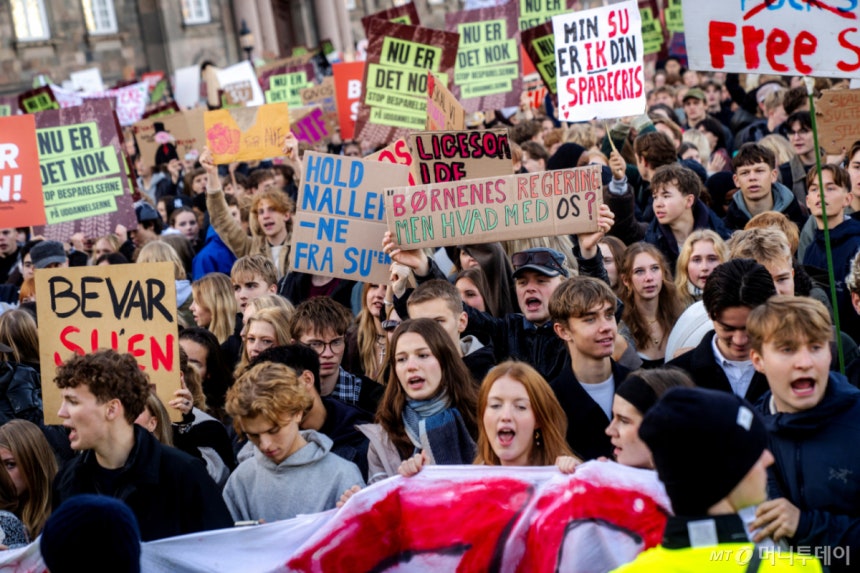
(Copenhagen Reuters=News1) Reporter Kim Beom-su = On the 4th (local time), high school and university students held a protest in front of the parliament building in Copenhagen, the capital of Denmark, against cuts to the education budget. To increase defense spending, the Danish government cut the budget for the welfare allowances it had paid to all students aged 18 and over. 2026.11.4 ⓒ Reuters=News1 Copyright (C) News1. All rights reserved. Unauthorized reproduction, redistribution, and use for AI training prohibited. /Photo=(Copenhagen Reuters=News1) Reporter Kim Beom-su
(Pension Future Forum comment:
The Pension Future Forum agrees with
the Money Today report, which emphasizes
depoliticization in the pension reform debate,
and hereby declares that
Korea’s pension reform debate, too,
can produce a proper solution
only if it returns
to the approach
of the early 2000s,
when genuine experts
led the discussion.)
[Sunday Morning Insight] Europe’s Bill for “From the Cradle to the Grave” — Pensions Are Swallowing National Budgets
[Editor’s Note]
(Uncertainty in global society has grown with the launch of the second Trump administration, the advance of AI, climate change, and more. Every Sunday morning, “Sunday Morning Insight” delivers the wisdom to navigate a world of growing uncertainty, with in-depth perspectives and sharp analysis.)
The pension models of Denmark, the Netherlands, and Sweden are not simply “funded-system success stories.”
These countries have layered occupational and individual funded pillars on top of basic protection and,
through linkage to life expectancy and automatic balancing mechanisms, have reduced the extent to which pension spending becomes the subject of political bargaining every time.
But this model presupposes decades of asset accumulation, long working lives, and relatively sound public finances.
For continental welfare states such as France and Italy, where population aging is already advanced and the burden of national debt is heavy, the transition costs are too high to replicate it in a short time.
◇How the Three Countries Spread the Shock
Denmark layered quasi-mandatory occupational pensions, based on collective agreements, on top of the state-paid basic pension. According to the Denmark country profile in “Pensions at a Glance 2023” by the Organisation for Economic Co-operation and Development (OECD), occupational pension contributions amount to 10–18% of wages. In its 2023 pension report, Better Finance, the European Federation of Investors and Financial Services Users, found that blue-collar workers generally pay 12% and white-collar workers 15–18%. According to statistics released by Danmarks Nationalbank in March, the total assets of pension companies reached 4.584 trillion kroner, or about 610 billion euros, at the end of last year. The public pension eligibility age is linked to life expectancy and will reach 70 in 2040, applying to those born in 1971 or later.
The Netherlands, which adds quasi-mandatory occupational pensions to its basic pension (AOW), ranks among the top countries: according to the OECD’s “Pensions at a Glance 2025,” published in November last year, its net income replacement rate for average earners reaches 96%. At the same time, it is carrying out a major transition, converting defined benefit (DB) occupational pensions into collective defined contribution (DC) schemes. It is a shift from a structure in which pension funds made relatively secure promises of future benefits to one in which investment returns and generation-specific risks are reflected more directly in each individual’s share.
Sweden did not abandon its pay-as-you-go system. It attached an automatic balancing mechanism to its Notional Defined Contribution (NDC) income pension, which accumulates contributions in individual notional accounts. When pension liabilities exceed assets, the size of benefit increases is automatically reduced. Sweden channels 2.5% of wages into individual funded premium pension accounts. The Swedish case shows that the key is not the switch to funding itself but an institutional design that makes it hard for politicians to change contribution rates, benefit formulas, and automatic adjustment rules at will.
According to “Old Continent, New Growth: Pension Reform as an Economic Engine for Europe,” a report published in January this year by the Boston Consulting Group (BCG) Henderson Institute, Denmark, the Netherlands, and Sweden account for only 12% of the gross domestic product (GDP) of the European Union (EU) as of 2024, but hold more than 60% of all EU pension assets across public, occupational, and individual pensions. Yet what the three countries have in common is not the scale of their funds so much as the automation of adjustment. In the same “Pensions at a Glance 2025,” the OECD projected that public pension spending will fall from 8.7% of GDP in 2023–24 to 7.8% in 2050 in Denmark, and from 8.0% to 7.0% in Sweden. Underlying this is a design that keeps politicians from haggling over pension spending anew every time.

View original Photo=BCG Henderson Institute graphic, AI-translated into Korean
◇The Price and the Limits: Why Continental Countries Cannot Follow Suit
This model, too, comes at a price. Labor groups protested Denmark’s eligibility age of 70, saying people would “lose a dignified old age.” Funded pensions are also exposed to financial market risk. If older people are hit by a market shock just before retirement, the controversy over benefit stability turns back into a political issue.
Sweden is moving in the same direction, but more slowly than Denmark. In January this year, Sweden introduced a “target age” system, which serves as the reference point for when pensions are drawn. The target age has been set at 67 until 2031 and will rise with life expectancy thereafter. According to projections by the Swedish Pensions Agency, it will be 68 for those born in 1967–1981, 69 for those born in 1982–1997, and 70 for those born in 1998 or later. Denmark’s pension eligibility age reaches 70 first because its link to life expectancy operates faster. Since the 2006 Welfare Agreement, Denmark has adjusted its pension eligibility age every five years in line with gains in life expectancy. Sweden, by contrast, reflects only two-thirds of the increase in life expectancy in the target age.
The Dutch transition is also feeding into financial market variables. According to a report released on June 25 by the Dutch financial group ING, pension funds worth about 600 billion euros moved this year from defined benefit to collective defined contribution schemes. In the process, the spread between 10-year and 30-year euro swap rates widened by a further 10–20bp (1bp = 0.01 percentage point). On January 1, 2027, more than 900 billion euros in pension assets, including those of ABP, the country’s largest pension fund, which covers civil servants, are scheduled to move to the new system. The interest rate hedge ratios ABP has disclosed—10% for young members and 75% for retirees—are lower than those of the funds that transitioned earlier. This means demand for long-term government bonds and swaps could fall correspondingly.
A more fundamental limit is time. In a report released on the 8th of last month, the Brussels think tank Bruegel found that the three countries’ pension assets were the result of decades of accumulation under favorable demographic and economic conditions and strong labor-management institutions. It concluded that “other EU countries will find it difficult to replicate the historical transitions that Denmark, the Netherlands, and Sweden went through.” According to the OECD’s “Pensions at a Glance 2025,” pension assets as of the end of 2024 reached 206.4% of GDP in Denmark, while in France they amounted to only 12.9%.
On the other side of the ledger lie unfunded liabilities. Bruegel estimated that, of the pensions continental countries have already promised, the portion that must be paid out of future contributions and taxes without any reserves often exceeds four times GDP. Switching to a funded system now would mean the working generation must keep shouldering existing retirees’ pensions on a pay-as-you-go basis while also filling their own accounts from scratch. It is a dual burden, in which one generation bears the costs of two systems at once.
The solution Bruegel proposed is a “kickstart”: the idea of having only fiscally sound countries issue government bonds worth 20–25% of GDP to seed citizens’ individual pension accounts with initial reserves. For France and Italy, whose debt already exceeds GDP, it is hardly a realistic option to begin with. In its World Economic Outlook (WEO) released on the 13th of last month, the International Monetary Fund (IMF) projected that general government gross debt will reach 118.5% of GDP in France and 137.9% in Italy this year. In the same January report, BCG also judged that only Germany could afford the option of borrowing to create a national pension fund, and Spain only to a limited extent. For France and Italy, its analysis is that “the risk that investment returns will fail to cover the cost of the additional debt is too great.”
In the end, what remains is the automatic mechanism.
But the same mechanism produces entirely different results depending on its political design.
The secret of the Swedish mechanism’s durability lies in its political lock.
The 1994 reform was crafted jointly by five parties holding 80% of the seats, and they formed a “Pension Group” and established the principle that changing the system requires the consent of every participating party.
The income pension is a closed structure that, with its contribution rate fixed, balances assets and liabilities outside the government budget.
Even when the “brake” that lowers pension increases was applied for the first time because of the 2008 financial crisis, the Pension Group made only an adjustment that smoothed the shock of the cuts by averaging it over three years, keeping the mechanism itself in place.
In August 2025, it also agreed on an “accelerator pedal” that distributes surpluses to beneficiaries once the surplus exceeds a certain level, and this year parliament enacted it into law.
Under this method, part of the surplus is distributed when assets exceed 1.15 times liabilities. Both the conditions for reductions and those for increases have thus been set in advance.
Even the automatic mechanism, however, is not entirely free of politics.
In a report published in December 2009, the Center for Retirement Research at Boston College in the United States assessed the changes made at the time as showing that even an automatic adjustment mechanism can give rise to political considerations aimed at offsetting it.
Germany’s sustainability factor was a mechanism of the same family, but it is regarded as having had a weak political shield.
Because it was a provision within the pension increase formula of an ordinary statute, it was put on the negotiating table every time the coalition changed.
From its introduction in 2004, it came with a safeguard clause ensuring that pensions would not fall because of the factor, and in 2009, during the financial crisis, this was expanded into a “pension guarantee” under which pensions would not be cut under any circumstances.
In the 2013 grand coalition negotiations, the Social Democratic Party (SPD) and the Christian Democratic Union and Christian Social Union (CDU/CSU) struck a trade: the SPD secured its “pension at 63,” aimed at skilled union workers, and the CDU/CSU its mothers’ pension, aimed at older women, each in exchange for the other. In November 2013, Der Spiegel called this the “senior grand coalition.”
In 2018, with the introduction of a floor that keeps the pension level from falling below 48% of average earnings, the factor effectively lost its force.
The pension package passed last December extends this floor to 2031 and adds the Mothers’ Pension III, which takes effect next January.
Sweden placed its mechanism outside the vote; Germany left its mechanism as a bargaining chip in coalition negotiations.
Even in Germany, which has fiscal room, the expansion of funded pillars is at an early stage.
The mandatory funded pillar of 2% of income, recommended by the Old-Age Security Commission and being pursued by the government, will be phased in from 2028 and is expected to reach 35 billion euros a year, or 0.8% of GDP, by 2031.
In a separate commentary published on the 8th of last month, Bruegel described it as no more than a starting point compared with the contribution rates of 10–18% in Denmark and the Netherlands.
The lesson of European pension reform is clear.
What matters more than whether a system is funded or pay-as-you-go is how robustly the automatic adjustment mechanism and the consensus structure are designed, so that adjustments to contribution rates, eligibility ages, and benefit formulas do not become the subject of political bargaining every time.
Pensions are a problem of governance before they become a problem of money. And when governance fails, the cost ultimately comes back to the budget and the government bond market.
Reporter Kim Ha-nui ([email protected])