(Korea JoongAng Daily) A President’s Reprimand, and a Minister’s Discomfort (KOR) (October 28, 2026)
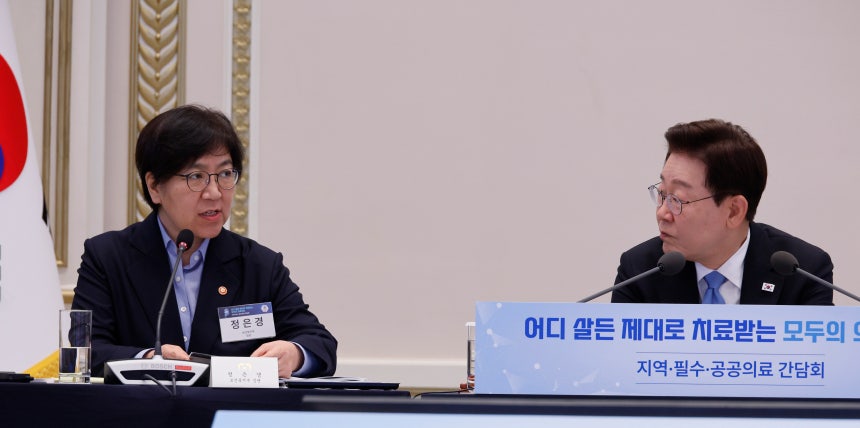
President Lee Jae Myung’s rebuke over youth pension support highlights the harder task of restoring trust in the system and pursuing structural reform.
Shin Sung-sik
The author is a welfare specialist reporter at the JoongAng Ilbo.
The atmosphere at the 45th Cabinet meeting on Oct. 20 turned tense for three minutes. President Lee Jae Myung resembled a scolding teacher, while Health and Welfare Minister Jung Eun-kyeong looked like a chastened student.
Lee interrupted Jung nearly 10 times, raised his voice, demanded to know the reason four times and sighed in frustration. At times, his language became unusually blunt. Jung maintained an awkward expression throughout. Lee's words took 1,070 Korean characters, compared to Jung's 429.
The dispute concerned a government plan to cover one month's National Pension Service (NPS) contribution, worth 42,000 won ($30), for 18-year-olds. Starting in January, eligible young people must apply to receive the benefit. Alongside abortion medication and universal menstrual products, the initiative exemplifies Lee's attention to detailed welfare policies.
Why did this seemingly minor issue provoke such anger?
People aged 18 to 27 are generally exempt from mandatory pension contributions while studying or serving in the military. However, making even one payment allows them to make additional contributions retroactively later, increasing their eventual benefits.
Since his days as Seongnam mayor, Lee has argued that only young people whose parents understand the system benefit from this arrangement, creating inequity. As Gyeonggi governor in 2018, he sought automatic government payments for 18-year-olds. But then-Health Minister Park Neung-hoo opposed the proposal, arguing that government-financed contributions contradicted social insurance principles.
Automatic support is not inherently harmful. Those who dislike the arrangement can simply decline to make retroactive payments. Lee argued that young people had no reason to object and that opposition stemmed from misunderstanding.
He pressed Jung to explain whether NPS finances were the real concern. Jung replied that officials had debated automatic enrollment but ultimately adopted applications to preserve individual choice.
Automatic support would indeed cost more, as Lee suggested. Yet another factor influenced the decision. Following last year's presidential election, the State Affairs Planning Committee revised the pledge after opposition from young people.
Many distrust the pension system, fearing they will contribute throughout their working lives without receiving benefits. An official familiar with the discussions recalled strong objections from young people who believed the government was trying to bind them to the pension system.
Why force them into participation merely to provide one month's contribution? Their reaction illustrates how deeply pension distrust has taken root.
Confucius taught that a nation cannot stand without public trust. Imposing automatic enrollment amid widespread suspicion could deepen that distrust.
Lee has consistently advocated replacing application-based welfare with automatic benefits. That approach works for universal programs such as child allowances and parental benefits. But the initial pension contribution for 18-year-olds raises different considerations.
Lee has also repeatedly questioned pension payments to foreigners, citing suspected abuse of NPS and basic pension benefits. At the Cabinet meeting, he demanded action against those who improperly received payments.
Recovering unlawfully obtained benefits is necessary, whether recipients are Korean or foreign. Singling out foreigners, however, risks appearing discriminatory.
Meanwhile, suspicions have emerged this year that the National Pension Fund is being used to support stock prices, an unusual controversy.
When stocks rose in May, Lee said he had heard that the fund's projected depletion date had been postponed by 20 to 30 years. Markets have since fallen, changing that calculation.
Assessing pension sustainability according to short-term market fluctuations is unusual. The law requires comprehensive actuarial assessments every five years, incorporating economic growth, demographic trends and other factors.
Detailed initiatives such as subsidizing the first contribution for 18-year-olds can be left to ministries. The president has more consequential pension challenges demanding attention.
These include reforming civil servants' and private schoolteachers' pensions, along with basic pension reforms that previous governments attempted but abandoned.
Such structural reforms would do more for younger generations than disputes over automatic enrollment.
Former President Roh Moo-hyun pushed through national pension reform through persistent persuasion. Former President Park Geun-hye reformed civil servants' pensions. Pension reform became a defining achievement of both presidencies.
The President Who Scolded, the Minister Who Was Scolded
Welfare Specialist Reporter Shin Sung-sik
The atmosphere at the 45th Cabinet meeting on the 20th was decidedly chilling. It stayed that way for exactly three minutes. President Lee Jae-myung looked like a teacher giving a scolding, and Jung Eun-kyeong, Minister of Health and Welfare, like a student being scolded. President Lee cut Minister Jung off nearly ten times. Voices rose; the president demanded “What is the reason?” four times and sighed, “Oh, dear.” At times President Lee slipped into curt, informal speech, along the lines of “Why is that a loss? It only gives them a benefit.” Minister Jung wore an awkward expression throughout. The president spoke 1,070 characters; Minister Jung, 429.
The issue that day was support covering one month of National Pension contributions (42,000 won) for 18-year-olds. It takes effect in January next year, and the support must be applied for (the application principle). Along with the abortion pill mifepristone and universal sanitary pads, it is one of President Lee’s signature ‘detail welfare’ policies. How important must it be for the president to get angry?
People aged 18 to 27 are not covered by the National Pension, in consideration of their studies, military service, and the like. But if they pay contributions even once, they can later pay arrears to increase their pension. Since serving as mayor of Seongnam, President Lee has been troubled that ‘only those whose parents know the system well make use of it’—in other words, that it is a problem of equity. As governor of Gyeonggi Province in 2018, Lee sought to pay contributions automatically for 18-year-olds. But Park Neung-hoo, Minister of Health and Welfare in the Moon Jae-in administration, blocked it, saying it “does not fit the fundamental principles of social security.” The point was that social insurance is a scheme in which contributions are paid when one has income, so having the government pay them runs counter to its purpose.
There is nothing wrong with ‘automatic support.’ Those who do not want it simply need not pay arrears. President Lee said, “There is no reason for young people to oppose it. It stems from a misunderstanding.” The president pressed Minister Jung, saying, “Speak frankly,” and “Is it not because of pension finances?” Minister Jung explained, “There was debate over whether to provide the first-contribution support automatically, but it was changed to the application principle, which gives people a choice.”
As the president said, automatic support would indeed cost more. But there is another reason it was changed to an application-based scheme. Right after last year’s presidential election, the State Affairs Planning Committee made this change while sorting out the campaign pledges. The reason was a backlash from young people. They distrust the pension, saying, “We will only pay contributions and get nothing back later.” An official well acquainted with the circumstances at the time says, “Young people objected strongly, asking, ‘Are you not trying to tie us to the pension?’” Why make a show of paying one month of contributions while trying to force people to enroll? That is how younger people push back. Distrust of the National Pension runs this deep.
Confucius said min mu sin bul rip (民無信不立), meaning that without the trust of the people, a state cannot stand. Pushing ahead amid deep distrust of the pension will only deepen that distrust. President Lee has emphasized breaking with the application principle in welfare. That works where everyone receives a benefit, as with the child allowance and the parental benefit, but the first-contribution policy for 18-year-olds is of a different nature.
President Lee is also persistent about pensions for foreigners. The president has pointed out several times that foreigners receive the National Pension and the Basic Pension by exploiting loopholes, and at the Cabinet meeting on the 20th said, “Measures are needed against those people (who received benefits through loopholes).” It is only natural that amounts received through loopholes or illegally be recovered. The same goes for Korean nationals. Emphasizing only foreigners could look like discrimination.
Since the start of this year, the National Pension has been engulfed in suspicions that it is being mobilized to prop up stock prices. In more than 20 years, this has rarely happened. When stock prices rose last May, President Lee said, “I heard that the projected date of pension fund depletion has been pushed back by 20 to 30 years.” Now stock prices have fallen and the situation has changed. Precedents for gauging the depletion date by the ups and downs of stock prices are also rare. The law stipulates that it be assessed every five years, taking comprehensive account of the growth rate, the population, and other factors.
Micro-level policies such as the first contribution at 18 can be left to the ministries. Items for the president’s agenda abound: reform of the Government Employees Pension and the Private School Teachers Pension, the Basic Pension reform that was begun and then retreated from, and more. Those are the things that would serve young people.
President Roh Moo-hyun pushed through National Pension reform by persuading again and again. President Park Geun-hye reformed the Government Employees Pension. Pension reform became the signature brand of both presidents.
BY OPINION DESK [[email protected]]
Copyright ⓒ Korea JoongAng Daily. All rights reserved. Unauthorized reproduction and redistribution prohibited