(Munhwa Ilbo, October 14, 2026) France's 'Fiscal Suffocation' [Afternoon Musings]
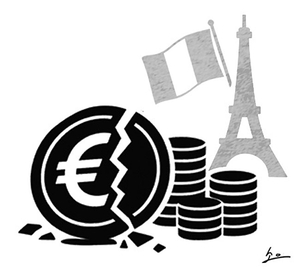
A red light has come on for France's public finances.
With the government's failure to control spending compounded by high interest rates, the country is being singled out as the weak link in fiscal instability.
France's national debt this year is projected to reach 119.3% of gross domestic product (GDP), and its fiscal deficit 5.4%.
To make matters worse, as market confidence wavers, the yield on 10-year government bonds is nearing 5%, the highest in 24 years.
Interest costs on government bonds alone now exceed the defense and education budgets, and even rolling over maturing bonds is no longer easy. Global credit rating agencies have warned of a sovereign credit rating downgrade.
Foreign holdings of French government bonds are very high at 56%, and Japanese institutional investors in particular hold more than 150 billion dollars. Thanks to its high 'AA-grade' credit rating, France has long been a favorite target of the yen carry trade. Recently, even leveraged investment has been rampant, with global hedge funds buying French government bonds by stacking 95% borrowed money on top of 5% of their own funds.
But the mood suddenly turned cold. When the Bank of Japan raised its policy rate, Sumitomo Mitsui DS Asset Management sold off all of its French government bonds. As bond prices plunged (yields rose) in the aftermath, hedge funds also joined the fire sale, and a vicious downward spiral set in.
The European Central Bank (ECB) could step in as the last-resort relief pitcher and buy government bonds. But the ECB is drawing a line, saying "fiscal reform comes first." France's political divisions are also making the situation worse. The Emmanuel Macron government has submitted a 50-billion-euro fiscal cutback plan to parliament, but it is running into trouble because of opposition from the far-left and far-right opposition parties.
Marine Le Pen, the front-runner in the next presidential election, and the National Rally (RN) are flip-flopping, pledging fiscal cuts while also trying to lower the pensionable age.
The chances that France, the eurozone's second-largest economy, will face a sovereign default any time soon are slim.
But its national burden ratio (taxes plus social security contributions) is already very high at 43.5% of GDP. Further tax increases are not an easy option, since the political backlash is all too predictable.
In the end there is no choice but to cut public spending and reduce pensions, yet students have already taken to the streets demanding "more money for the education budget."
François Villeroy de Galhau, former governor of the central bank, warned, "If public finances are not brought under control quickly, the country will fall into a 'state of suffocation.'"
The countdown to a French fiscal crisis has begun.